
DDoS attacks don’t always look like sudden outages. Sometimes they start as subtle latency spikes, exhausted thread pools, or “normal-looking” traffic that quietly overwhelms your application.This guide breaks down Volumetric, Protocol, and Layer 7 DDoS attacks from a real-world, cloud-native perspective—using traffic logs, architectural patterns, and U.S.-specific compliance and risk considerations to help you understand not just what breaks, but why.
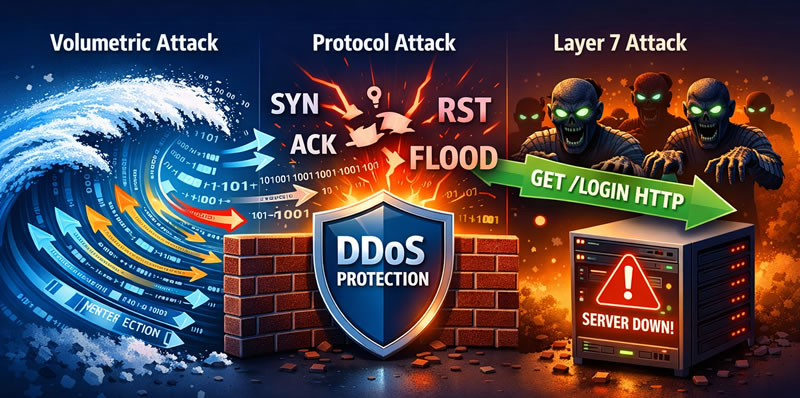
Volumetric, Protocol, and Layer 7 Attacks in AWS, Azure, and Google Cloud
In the United States, most production systems no longer live on bare metal or single-provider data centers. They run on AWS, Azure, Google Cloud, or hybrid combinations stitched together with CDNs, managed load balancers, and third-party APIs.
That reality fundamentally changes how DDoS attacks behave — and how they are mitigated.
Modern DDoS defense is not just about “absorbing traffic.” It’s about architectural resilience, compliance obligations, insurance requirements, and operational readiness. This version of the article reflects that reality.
1. Volumetric Attacks in Cloud Environments
How Hyperscalers Absorb Traffic (and When They Don’t)
Volumetric attacks still aim to saturate bandwidth, but in cloud environments, the choke point is rarely your EC2 instance or VM. It’s more often:
- The CDN edge
- The managed load balancer
- Or the provider’s regional ingress capacity
AWS, Azure, GCP: What Happens Automatically
| Cloud Provider | Native Protection | Default Coverage |
|---|---|---|
| AWS | AWS Shield Standard | Always on, free |
| Azure | Azure DDoS Protection Basic | Always on |
| GCP | Infrastructure-level protection | Always on |
These baseline services automatically mitigate:
- UDP floods
- SYN floods
- Reflection and amplification attacks
In practice, a 500 Gbps DNS amplification attack rarely reaches your VPC. It is absorbed upstream, often without you ever seeing the packets.
The Catch: Visibility and Cost
When traffic is scrubbed at scale:
- Logs may be sampled or delayed
- Metrics lag behind real-time
- For advanced services, costs can spike
AWS Shield Advanced, for example:
- ~$3,000/month per account
- Includes cost protection for scaling during attacks
- Provides access to the DDoS Response Team (DRT)
This matters for US companies because unexpected scaling costs during attacks are a real financial risk.
2. Protocol Attacks and Managed Load Balancers
State Exhaustion Still Works — Just Differently
In cloud-native setups, protocol attacks target:
- ALB / NLB connection tables
- Azure Front Door state
- GCP TCP proxy backends
Example: SYN Flood Against an ALB
Even though AWS absorbs raw traffic, a SYN flood can still:
- Push ALB connection counts to limits
- Increase latency for legitimate clients
- Trigger autoscaling events (cost + instability)
Key metric example:
- Active connections jump from 20k → 200k
- p95 latency increases from 80ms → 900ms
- Error rate remains “low” — misleading dashboards
Mitigation Layer
- Shield Standard handles raw floods
- Shield Advanced improves detection thresholds
- Proper idle timeout and connection reuse settings are critical
3. Layer 7 Attacks: Where Cloud Defaults Fail
The Most Expensive, Least Obvious Attacks
Layer 7 attacks are where cloud-native systems are most vulnerable.
They pass through:
- CDN
- Load balancer
- TLS termination
- Application code
Realistic US Scenario (Seen Often)
A SaaS company exposes a search endpoint:
POST /api/v2/search
Traffic volume:
- Only 20–30 requests per second
- Spread across thousands of IPs
Impact:
- p95 response time degrades from 200ms to 2,000ms
- Thread pools reach 95% saturation for 7–10 minutes
- CPU stays under 60%
- Auto-scaling never triggers correctly
This is a textbook low-and-slow Layer 7 attack.
4. WAF and Cloud-Native Layer 7 Defense
AWS WAF + CloudFront + Shield (Common Pattern)
| Layer | Role |
|---|---|
| CloudFront | Global traffic absorption |
| AWS WAF | Rate limiting, bot control |
| Shield Advanced | Attack visibility + cost protection |
Effective controls include:
- Per-endpoint rate limits
- Bot Control managed rules
- Geo and ASN-based filtering
- CAPTCHA / challenge responses
Azure and GCP Equivalents
- Azure DDoS Protection + Front Door + WAF
- Google Cloud Armor + HTTP(S) Load Balancer
All three providers converge on the same principle:
Volumetric and protocol attacks are handled automatically.
Layer 7 defense is your responsibility.
5. Compliance: Why DDoS Is Not Optional in the US
In the US, DDoS resilience is increasingly interpreted as due diligence, not just best practice.
Key Regulatory Touchpoints
| Regulation | Relevance to DDoS |
|---|---|
| PCI DSS | Requirement 11.4 (stress testing, resilience) |
| HIPAA | Availability of ePHI systems |
| FINRA | Business continuity and operational resilience |
| FedRAMP | Continuous monitoring and attack preparedness |
A payment processor suffering repeated outages may be found non-compliant even if no data is breached.
6. Cyber Insurance: The Hidden Driver
In the US market, cyber insurance underwriters increasingly ask:
- Do you use a CDN?
- Is WAF enabled and tuned?
- Are DDoS runbooks documented?
- Have you tested failover and rate limiting?
The “Common Architectural Mistakes” listed earlier are literal red flags for insurers.
Real consequence:
- Higher premiums
- Exclusions for DDoS-related downtime
- Or outright policy denial
DDoS defense is now a financial control, not just a technical one.
7. Internal Threats, APIs, and Vendor Risk
Many sophisticated Layer 7 incidents are not anonymous botnets.
They originate from:
- Leaked API keys
- Compromised vendor integrations
- Misconfigured webhooks
Example
A third-party analytics service is compromised.
It continues sending authenticated requests.
Traffic is “legitimate.”
Rate limits don’t trigger.
Result:
- Silent application exhaustion
- Billing spikes
- Weeks before root cause is found
API authentication, key rotation, and vendor scoping are part of DDoS defense.
8. Metrics That Actually Matter
Instead of vague indicators, US-based teams track:
- p95 / p99 latency (not averages)
- Thread pool utilization >90%
- Queue depth over time
- Error budget burn rates
Expanded DDoS Comparison Table
| Type | Traffic Volume | Detection Difficulty | Typical Duration | RTO Impact |
|---|---|---|---|---|
| Volumetric | Very High | Low | Minutes–Hours | Low (with CDN) |
| Protocol | Medium | Medium | Hours | Medium |
| Layer 7 | Low | High | Days–Weeks | High |
9. Logs That Matter in US Cloud Environments
When investigating attacks, the most valuable logs are:
- AWS CloudFront Logs → stored in S3
- AWS WAF Logs → CloudWatch Logs Insights
- ALB Access Logs → request-level latency
- Azure Front Door Analytics
- GCP Load Balancer Logs
Patterns to look for:
- Repeated endpoint access with low variance
- Gradual latency creep before error spikes
- Authenticated abuse patterns
Closing Thought
In US cloud environments, DDoS is no longer a question of “Can we survive traffic?”
It’s a question of:
- Architectural maturity
- Compliance posture
- Insurance eligibility
- Operational discipline
The attacks haven’t gotten simpler.
Our explanations just need to catch up to reality.
From here, the natural continuation is:
- Cloud-specific attack simulations
- WAF rule tuning strategies
- Incident response runbooks aligned with compliance and insurance expectations
This version is the map. The terrain is production.
Related Posts
What to Do During a DDoS Attack (The First 15 Minutes)

When a DDoS attack starts, the first 15 minutes often decide how serious the impact will be.
This guide walks you through exactly what to do during those critical moments — from identifying real attack traffic to activating protection measures and communicating clearly with users.
Written from real-world incident response experience, the article focuses on calm decision-making, practical actions, and minimizing service disruption without panic or guesswork.
Social Engineering Attacks: The Psychology, the Mechanics, and the Legal Fallout

Social engineering attacks bypass firewalls by targeting human psychology. Authority, urgency, trust, and cognitive bias are weaponized to turn employees into entry points.
This section explores how modern social engineering campaigns are built — from psychological manipulation and technical deception to real-world attack anatomy and legal consequences under GDPR and global data protection laws.
Layer 7 DDoS: Attacks That Behave Like Real Users

Layer 7 DDoS attacks do not rely on massive traffic floods. Instead, they quietly exploit expensive application endpoints while behaving like legitimate users. This technical article explains how these attacks work, why traditional defenses fail, and how modern systems detect and mitigate them.
What Is a DDoS Attack? Why Do Websites Suddenly Go Down?
DDoS attacks are one of the most misunderstood causes of website downtime.
In this category, we explain how distributed attacks work, how bot traffic overwhelms servers, and how CDNs and web security layers help keep sites online — without fear-driven language or technical noise.
The goal is simple: understand the problem clearly before choosing the right protection.

Pupuler Post