
A free VPN can feel like a small victory. One click, a promise of privacy, no credit card required. It sounds almost too good to question. And yet, in the digital world, convenience often comes with invisible strings attached. When it comes to VPNs, the real cost is not always measured in money, but in speed, privacy, and trust.So the real question is not “Why pay for a VPN?” but rather “What am I giving up if I don’t?”
Understanding Free VPNs
Free VPNs are services that allow users to route their internet traffic through encrypted tunnels without charging a subscription fee. They are widely available as mobile apps, desktop software, or browser extensions, and they usually attract users with simplicity and zero upfront commitment.
However, maintaining servers, infrastructure, and bandwidth is expensive. If users are not paying with money, they are often paying in other ways.
For instance, many free VPNs rely on advertising. Some limit daily data usage or reduce connection speeds. Others collect usage data—sometimes anonymized, sometimes not—to analyze behavior or monetize it through partnerships. Buried deep in privacy policies, phrases like “service improvement” or “aggregated analytics” often hint at this trade-off.
In practice, this can mean slower connections, frequent ads, and limited transparency about what happens to your data once it passes through the VPN server.
A Real-World Scenario
Imagine connecting to a free VPN at an airport while checking your email or logging into a personal account. The VPN connects, but the server is crowded. The connection stutters. At some point, it drops for a second. If there is no automatic kill switch, your real IP address is briefly exposed.
Nothing dramatic happens. Or so it seems.
Moments like these rarely feel dangerous, but they are precisely where free VPNs show their cracks. They work—until they don’t.
Browser-Based Free VPNs: A Partial Shield
Many free VPNs exist only as browser extensions. These tools protect traffic inside the browser but leave everything else untouched. Background applications, cloud sync tools, messaging apps, and system updates bypass the VPN entirely.
This creates a false sense of security. The user feels protected, while large portions of device traffic remain exposed. It is like locking the front door while leaving the windows open.
What Paid VPNs Do Differently
Paid VPNs operate on a simpler, more transparent logic: users fund the service, and the service protects the users. This shift changes everything.
Because revenue comes from subscriptions, reputable paid VPN providers invest heavily in infrastructure. They offer stronger encryption, stable connections, and clearly stated no-log policies. Many are independently audited to prove they do not store user activity.
Consider a remote worker who switches between home Wi-Fi, mobile data, and public networks throughout the day. A paid VPN typically maintains a stable tunnel across these changes, reconnects instantly if the signal drops, and blocks all traffic if the VPN disconnects unexpectedly.
The protection is quiet, consistent, and largely invisible—which is exactly how security should feel.
Speed and Performance: The Hidden Difference
Free VPN servers are often overcrowded. Thousands of users share limited resources, which leads to buffering videos, delayed page loads, and unpredictable disconnections. Streaming platforms may detect and block these servers entirely.
Paid VPNs, by contrast, distribute users across a larger server network. Many even offer specialized servers optimized for streaming, gaming, or secure file transfers. The result is smoother performance and far fewer interruptions.
Over time, this difference becomes impossible to ignore.
Privacy: Where the Line Is Drawn
The most important distinction between free and paid VPNs lies in privacy.
With many free services, the user is not the customer but the product. Data—connection times, device types, usage patterns—can become part of the business model.
Paid VPNs, especially those with strict no-log policies, reverse this relationship. The company’s survival depends on user trust. Losing that trust means losing the business.
In other words, one model asks, “What can we learn from the user?” The other asks, “How do we protect the user better?”
When Does a Free VPN Make Sense?
Free VPNs can still serve a purpose. For quick, low-risk tasks—such as briefly hiding an IP address or accessing non-sensitive content—they may be sufficient. They can also help users understand how VPNs work before committing financially.
However, for activities involving personal data, financial accounts, work communication, or frequent use of public Wi-Fi, the limitations quickly outweigh the benefits.
Conclusion
Free VPNs offer a tempting shortcut, but shortcuts rarely lead to safe destinations. Paid VPNs, while requiring a subscription, provide stability, transparency, and peace of mind that free alternatives struggle to match.
In the end, the decision is not about spending money. It is about deciding what your privacy is worth. In a digital environment where data is endlessly collected, choosing how—and by whom—it is protected may be one of the most practical security decisions you make.
Related Posts
Is Using a VPN Legal? A Country-by-Country Look at Laws, Limits, and Grey Areas
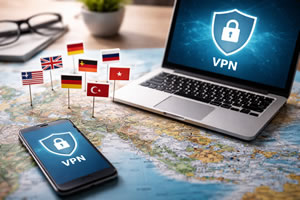
Virtual Private Networks, better known as VPNs, have quietly moved from the tech-savvy fringe into everyday life. People use them to protect their privacy on public Wi-Fi, secure remote work connections, or access information while traveling. For many, a VPN feels like a digital seatbelt: something you put on for safety, not because you plan to crash.
That popularity naturally leads to a bigger, more uncomfortable question. If VPNs are so widely used, are they actually legal everywhere in the world?
The short answer is: mostly yes—but not always, and not without important caveats.
What Is a VPN? How It Works and Why It Matters for Online Security
Every time you connect to the internet, you leave behind a trail of data—often without realizing how visible it is or who might be watching. From public Wi-Fi networks to data-hungry platforms and cybercriminals, the modern internet is not exactly a private place. This is where a VPN quietly steps in. Not as a flashy tool, but as a practical layer of digital protection that helps you take back control of your online presence.
Understanding what a VPN is—and what it is not—is an essential part of digital literacy today.
What Is a VPN? How It Works and Why It Matters for Your Online Security
A Virtual Private Network, or VPN, is one of those technologies that quietly works behind the scenes to protect your privacy while you browse, stream, or work online. It routes your internet traffic through an encrypted tunnel and masks your IP address, making it far harder for advertisers, hackers, or even your internet provider to track what you do. Understanding how VPNs work isn’t just for tech professionals anymore—it's a practical skill that helps anyone stay safe in a world where digital surveillance grows by the day.

Pupuler Post